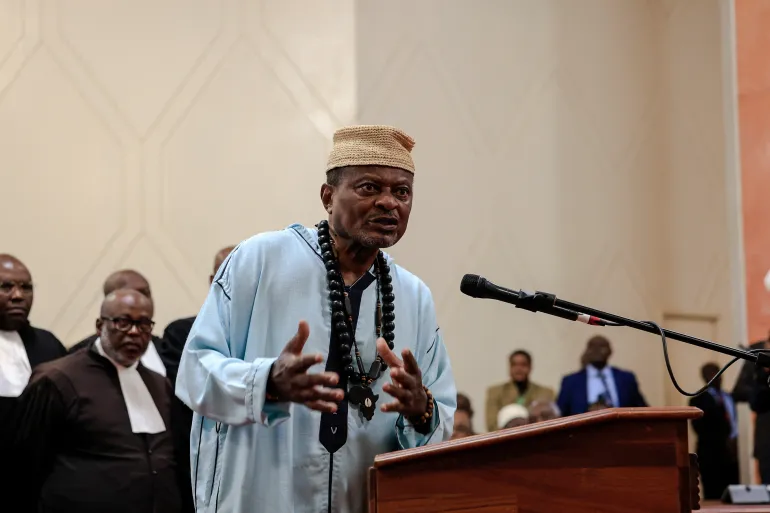
Who was Anicet Ekane
African Movement for New Independence and Democracy (MANIDEM) veteran politician Anicet Ekane born in Douala in April 1951 had spent nearly five decades fighting for democratic reforms and social justice in Cameroon.
Ekane joined the opposition early, originally part of the Union of the Peoples of Cameroon (UPC) before founding MANIDEM in 1995.
He ran for president in 2004 and 2011 under MANIDEM and in 2025 threw his weight behind another opposition candidate a move that would make him a target after the contentious October election.
Arrest and Detention: What Happened
On 24 October 2025, shortly after disputed presidential election results were announced returning Paul Biya to power Ekane was arrested in Douala. His party described the arrest as a “kidnapping” by soldiers.
Authorities charged him with serious crimes including “insurrection,” “incitement to revolt,” and “hostility against the state.” Supporters and his legal team dismissed these as politically motivated.
He was transferred to detention under the supervision of the state defence administration in Yaoundé (the SED).
Death in Custody Allegations and Official Response
On 1 December 2025, at age 74, Ekane died while in military detention in Yaoundé. The government stated he died of an illness and that he had received treatment at the National Gendarmerie Military Medical Centre.
But his family, lawyers, and party strongly reject that account. According to his son, Ekane had suffered severe respiratory distress during his last week in detention — he was “suffocating” and repeatedly denied proper treatment despite pleas from family and legal counsel.
His oxygen concentrator and other vital medical equipment were reportedly confiscated when he was arrested, and remained inaccessible while he was in detention.
Civil society groups and rights organizations have described his death as a grave violation of detainee rights, pointing to systemic issues in Cameroon’s detention conditions and calling for an impartial international investigation.
Reaction — Outrage, Mourning, and Calls for Justice
Members of MANIDEM and other opposition parties are mourning the loss of a veteran activist, describing his death as a blow to hopes for a “democratic Cameroon.”
The party and many civil society organizations have denounced the detention as arbitrary and the denial of medical care as deliberate neglect — some even calling it a “murder.”
International actors have also weighed in: the European Union delegation to Cameroon expressed “deep sadness” and renewed calls for the release of all arbitrarily detained political actors.
The government has announced that an investigation has been launched into the circumstances surrounding Ekane’s death.
Why This Matters — The Bigger Picture
Ekane’s death is more than the loss of an individual. It signals deep and systemic issues concerning political repression, arbitrary detention and detainee treatment in Cameroon. As noted by rights groups, this case could reflect a broader pattern of neglect and abuse of political prisoners.
At a time when the 2025 election and its aftermath have sparked widespread protests, arrests, and alleged violence — with opposition groups claiming civilian deaths far exceeded official tallies — the death of a senior opposition figure while in custody threatens to further erode trust in institutions and inflame political tensions.
For many, Ekane’s story is emblematic of the dangers faced by political dissenters: decades pushing for reforms, only to end up detained — and dead — under murky circumstances.
Final thought: The death of Anicet Ekane demands more than condolences — it requires accountability. An independent, transparent investigation is essential, not just for justice for Ekane and his family, but to preserve the dignity of political dissent and human rights in Cameroon.
